Managing heavy structural debris requires rigorous load containment that complies with municipal ordinances and jobsite safety rules. In Houston, residential remodels in historic districts like The Heights and Montrose…
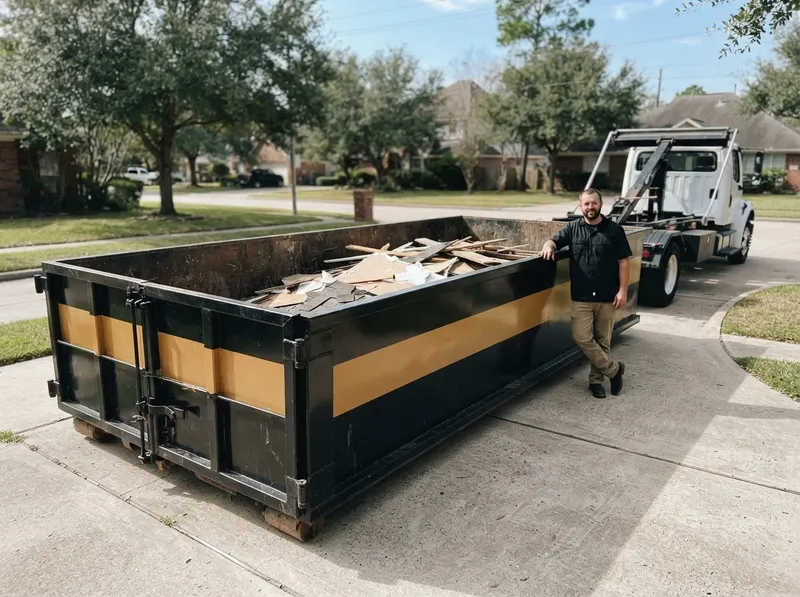
Managing heavy structural debris requires rigorous load containment that complies with municipal ordinances and jobsite safety rules. In Houston, residential remodels in historic districts like The Heights and Montrose often deal with narrow streets, low-hanging live oak canopies, and strict curb-parking rules enforced by the City of Houston Parking Management. Placing a roll-off bin on a public street requires a formal right-of-way permit through Houston Permitting Center, whereas setting the bin directly on private driveways in River Oaks or Memorial bypasses street obstruction permits entirely. RapidBin Disposal lays structural timber runners beneath every steel wheel assembly before lowering the container, isolating bare concrete and decorative pavers from friction cracks and asphalt pressure gouges.
Selecting the correct container dimension prevents overload lockouts and municipal transport violations. Dense materials like broken slabs, brick, and subfloor masonry weigh roughly 2,000 to 3,000 pounds per cubic yard, which means heavy masonry tear-outs must utilize low-profile containers to remain within axle weight limits defined by the Texas Department of Public Safety. The 10-yard dumpster at $595 and the 15-yard bin at $650 handle high-density kitchen wall tear-outs, bath gutting, and tile removals in Meyerland and West University Place without exceeding the legal road limits monitored by the Texas Department of Transportation. Conversely, whole-house roofing tear-offs or commercial interior demolitions in EaDo (East Downtown) generate bulky, lightweight debris such as insulation, corrugated decking, and drywall, which efficiently fills a 30-yard dumpster at $795 or a 40-yard bin at $895. The operational trade-off centers strictly on material density versus volumetric footprint: heavy aggregate debris requires smaller, lower-profile boxes to avoid highway weight penalties, while framing lumber and siding require tall, high-capacity sidewalls to contain volume.
Site layout dictates container logistics, especially during severe weather seasons across the Gulf Coast. Wet clay soils in Clear Lake, Oak Forest, and Kingwood can destabilize heavy delivery machinery, making reinforced gravel pads or wide concrete approaches mandatory during periods of intense rainfall. Contractors managing active build sites must coordinate continuous access under standard guidelines from the Occupational Safety and Health Administration to protect workers during mechanized loading. All recovered materials travel directly to licensed solid waste infrastructure operating under environmental mandates set by the Texas Commission on Environmental Quality and broader resource recovery rules from the United States Environmental Protection Agency. Clean scrap timber and structural steel members are channeled to regional industrial processors in line with salvage guidance from the Associated General Contractors of America and recycling initiatives outlined by the U.S. Green Building Council. RapidBin Disposal ensures all project timelines stay intact by providing flat-rate billing, predictable delivery windows, and certified waste routing across all Harris County communities.
Every job gets a firm, written price after a free on-site visit.
For standards, safe disposal, and service guidance on DUMPSTER in Houston, TX, useful references include U.S. EPA, EPA, EPA, OSHA, Earth911, and Google Maps. General consumer and small-business resources are available from USA.gov, Better Business Bureau, FTC Consumer Advice, U.S. Small Business Administration, and Ready.gov.
Tell us about your construction and demolition dumpster job in Houston and we'll send a clear, written quote, usually the same day.
 RapidBin Disposal